Skip to the content
FilCommunityWorkflowsDocsOpen Fil
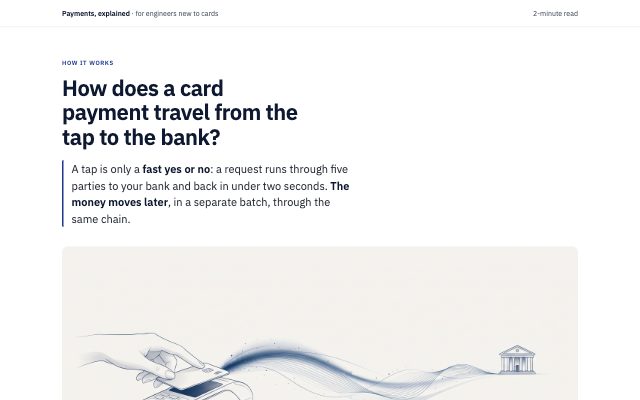
A cover picture for the explainer in Topic.md: a contactless card tapping a payment terminal, with a soft trail of deep…

Image · Nano Banana 2.1

A cover picture for the explainer in Topic.md

A cover picture for the explainer in Topic.md: a contactless card tapping a payment terminal, with a soft trail of deep blue light running off toward a distant bank building on the horizon, a clean editorial illustration on a plain light background, calm white and one deep blue accent, no text. Reference (Topic.md): # Topic - **Question:** How does a card payment travel from the tap to the bank? - **For:** Engineers new to payments. They know how software systems and APIs work, but nothing about cards, banks or how money moves between them. - **They should understand:** A tap is only a fast yes or no. The money moves later, in a separate batch, through the same chain of parties. - **The parts:** Card, terminal, acquirer (the shop's bank), card network, issuing bank (the cardholder's bank). Explain each with an everyday analogy and no protocol names: the card is a key, the terminal a messenger, the acquirer the shop's bank, the card network a postal sorting hub, the issuing bank the keeper of the cardholder's money. - **The steps:** 1. The customer taps the card on the terminal. 2. The terminal reads the card and sends a request to the acquirer. 3. The acquirer passes it to the card network. 4. The network routes it to the issuing bank. 5. The issuing bank checks funds and risk, then answers yes or no. 6. The answer travels back through the network and acquirer to the terminal, which shows approved or declined. 7. Later, in a batch, the money is settled from the issuing bank to the shop's account. - **Compare:** Authorization vs settlement. Authorization is the instant approval that holds the amount and happens in seconds. Settlement is the batch that actually moves the money, usually a day or more later. Rows: when it happens, what it does, who is involved, what the shop sees. - **Numbers:** Under 2 seconds for an approval. About 2% in fees on a typical sale. 1 to 2 days for the money to arrive. 5 parties between the tap and the bank. - **Look:** Light and editorial: a calm white page with one deep blue accent, like a good technical magazine. One typeface family, generous space. - **Sources:** None. Draw only on the notes above.

Meng To@shadownessguy0097
Model
Nano Banana 2.1
Made by
Meng To
Shared
Likes
0
Open in Fil

Use its prompt, turn it into a video or a 3D model, or find more like it in Fil. Fil is invite-only for now: without an invitation, Open in Fil shows the waitlist.
More like this

The visual explainer for Topic.md, following the skill, with the wired cover picture. Reference (Topic.md): # Topic…The visual explainer for Topic.md, following the skill, with the wired cover picture. Reference (Topic.md): # Topic - **Question:** How…The slides from the skill for the whole day, following the wired day plan, with the wired cover and project visuals…The slides from the skill for the whole day, following the wired day plan, with the wired cover and project visuals. Reference…Slide 1 from Talk.md, the skill’s title slide: a tiny boat with one warm orange lantern outpacing a huge dark ship on a…Slide 1 from Talk.md, the skill’s title slide: a tiny boat with one warm orange lantern outpacing a huge dark ship on a calm deep navy sea…Slide 2 from Talk.md, one of the skill’s idea slides, in the look of the wired Slide 1. Reference (Talk.md): # Talk…Slide 2 from Talk.md, one of the skill’s idea slides, in the look of the wired Slide 1. Reference (Talk.md): # Talk - **Title:** Small…Slide 4 from Talk.md, one of the skill’s idea slides, in the look of the wired Slide 1. Reference (Talk.md): # Talk…Slide 4 from Talk.md, one of the skill’s idea slides, in the look of the wired Slide 1. Reference (Talk.md): # Talk - **Title:** Small…Slide 3 from Talk.md, one of the skill’s idea slides, in the look of the wired Slide 1. Reference (Talk.md): # Talk…Slide 3 from Talk.md, one of the skill’s idea slides, in the look of the wired Slide 1. Reference (Talk.md): # Talk - **Title:** Small…Slide 5 from Talk.md, one of the skill’s idea slides, in the look of the wired Slide 1. Reference (Talk.md): # Talk…Slide 5 from Talk.md, one of the skill’s idea slides, in the look of the wired Slide 1. Reference (Talk.md): # Talk - **Title:** Small…Spread 2 from Story.md, as the skill’s spreads, with the hero exactly as on the wired hero sheet. Reference (Story.md): #…Spread 2 from Story.md, as the skill’s spreads, with the hero exactly as on the wired hero sheet. Reference (Story.md): # Story…Spread 1 from Story.md, as the skill’s spreads, with the hero exactly as on the wired hero sheet. Reference (Story.md): #…Spread 1 from Story.md, as the skill’s spreads, with the hero exactly as on the wired hero sheet. Reference (Story.md): # Story…The last slide from Talk.md, the skill’s last slide, in the look of the wired Slide 1. Reference (Talk.md): # Talk…The last slide from Talk.md, the skill’s last slide, in the look of the wired Slide 1. Reference (Talk.md): # Talk - **Title:** Small…Spread 5 from Story.md, as the skill’s spreads, with the hero exactly as on the wired hero sheet. Reference (Story.md): #…Spread 5 from Story.md, as the skill’s spreads, with the hero exactly as on the wired hero sheet. Reference (Story.md): # Story…Spread 4 from Story.md, as the skill’s spreads, with the hero exactly as on the wired hero sheet. Reference (Story.md): #…Spread 4 from Story.md, as the skill’s spreads, with the hero exactly as on the wired hero sheet. Reference (Story.md): # Story…